EEG-to-Image Generation for Brain Injury Rehabilitation (ArXiv)
Research mentorship with Harvard Medical School on EEG-to-image generation, reproducibility, and model comparison. Preprint on arXiv.
OVERVIEW
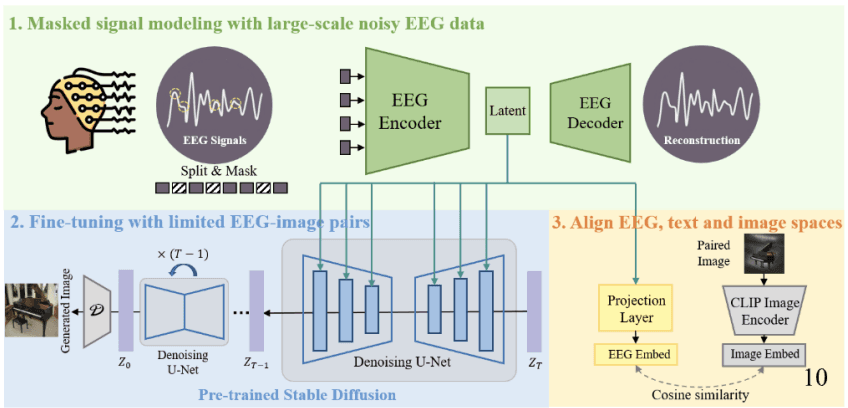
I worked on getting the DreamDiffusion pipeline into a state that others could actually run. The original repository had dependency conflicts and environment drift, so I helped migrate the workflow to Google Colab and debug architecture-level failures. We also compared approaches across SVMs, feedforward networks, CNN encoders, GANs, and VAEs for EEG-to-image reconstruction. The central technical issue stayed the same: EEG is noisy, nonlinear, and temporally complex, so naive mappings from signal to image collapse quickly. That is why the CLIP-aligned diffusion approach mattered in this project.
WHAT I DID
- Refactored and debugged the DreamDiffusion codebase into a reproducible Google Colab pipeline, resolving dependencies, setup errors, and environment incompatibilities.
- Implemented EEG preprocessing and representation pipelines, dealing with EEG's low signal-to-noise ratio and temporal structure
- Evaluated multiple ML and deep-learning paradigms, and explored CLIP's multimodal latent space, enabling Stable Diffusion to generate images via EEG-derived data.
- Worked with a team of 3 other peers to write a 13-page research paper, exploring our findings and documenting the methodologies and insights we made.
RESULTS / IMPACT
- Produced a reproducible Colab workflow with setup fixes, cleaner docs, and runnable notebooks.
- Demonstrated diffusion-based latent-space generation is more effective for EEG-to-image generation than CNNs, GANs, VAEs, or SVM models.
- Wrote a paper published to ArXiv as a pre-print.
LESSONS + NEXT STEPS
- Keep this as a research workflow; avoid over-claiming product readiness.
- Integrate wavelet-based and time-frequency features to better capture transient EEG dynamics
PAPER PREVIEW
Scroll through the preprint directly here. For citation / sharing, use the arXiv link above.
GALLERY